Journal of Endocrinology and Metabolism, ISSN 1923-2861 print, 1923-287X online, Open Access
Article copyright, the authors; Journal compilation copyright, J Endocrinol Metab and Elmer Press Inc
Journal website https://jem.elmerpub.com

Original Article

Volume 16, Number 1, February 2026, pages 22-28


Relationship Between Subclinical Hypothyroidism and Cardio-Ankle Vascular Index: A Cross-Sectional Study

Figures

Figure 1.
Figure 1. The relationship between CAVI and thyroid function. (a–c) Comparison of uTSH, FT3, and FT4 in subjects CAVI < 9 and ≥ 9. (d) Correlation analysis between uTSH and CAVI. *A statistically significant difference was observed between the groups (CAVI < 9 vs. ≥ 9), with a P value < 0.001. CAVI: cardio-ankle vascular index; FT3: free triiodothyronine; FT4: free thyroxine; uTSH: ultrasensitive thyroid-stimulating hormone.
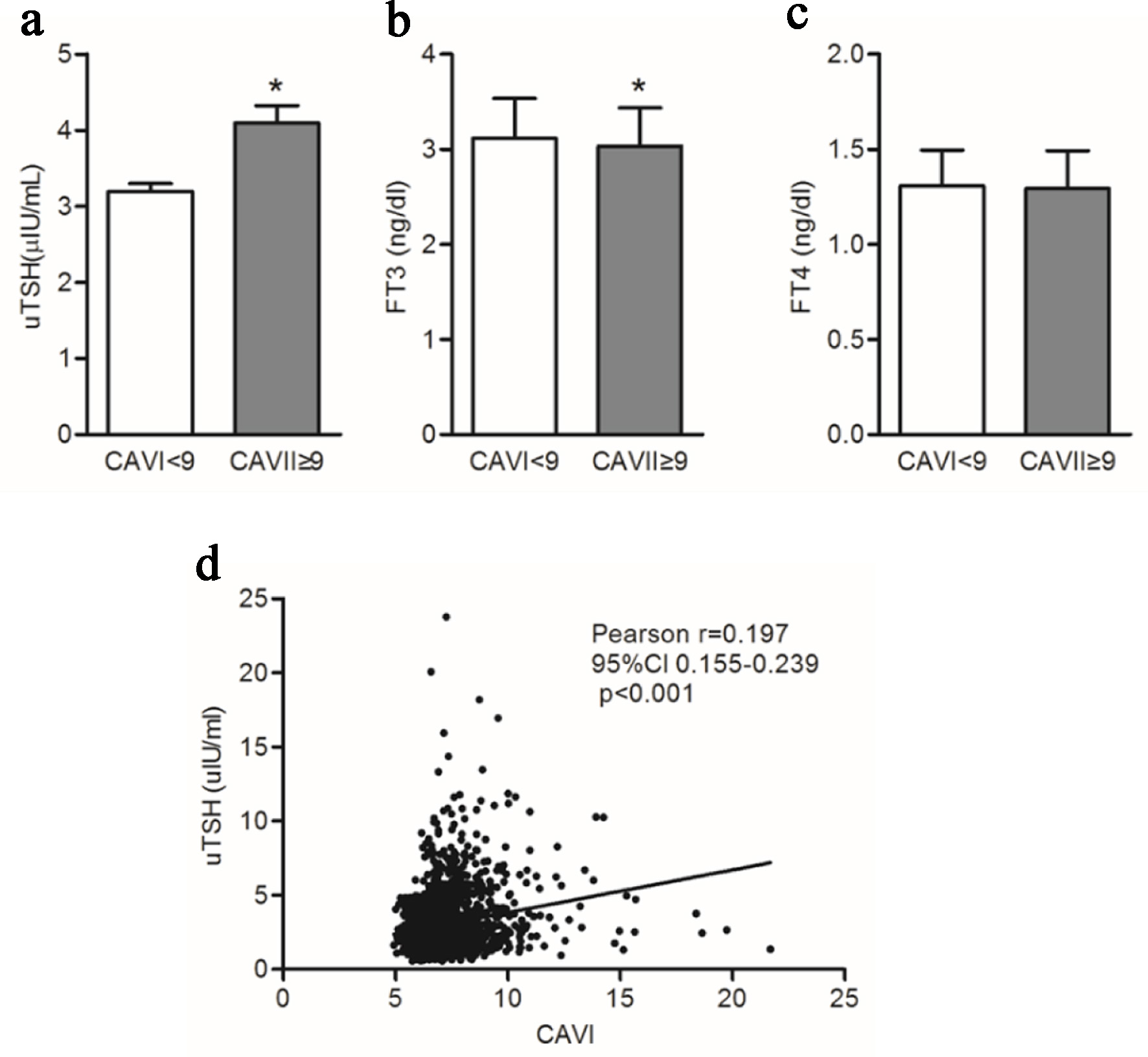
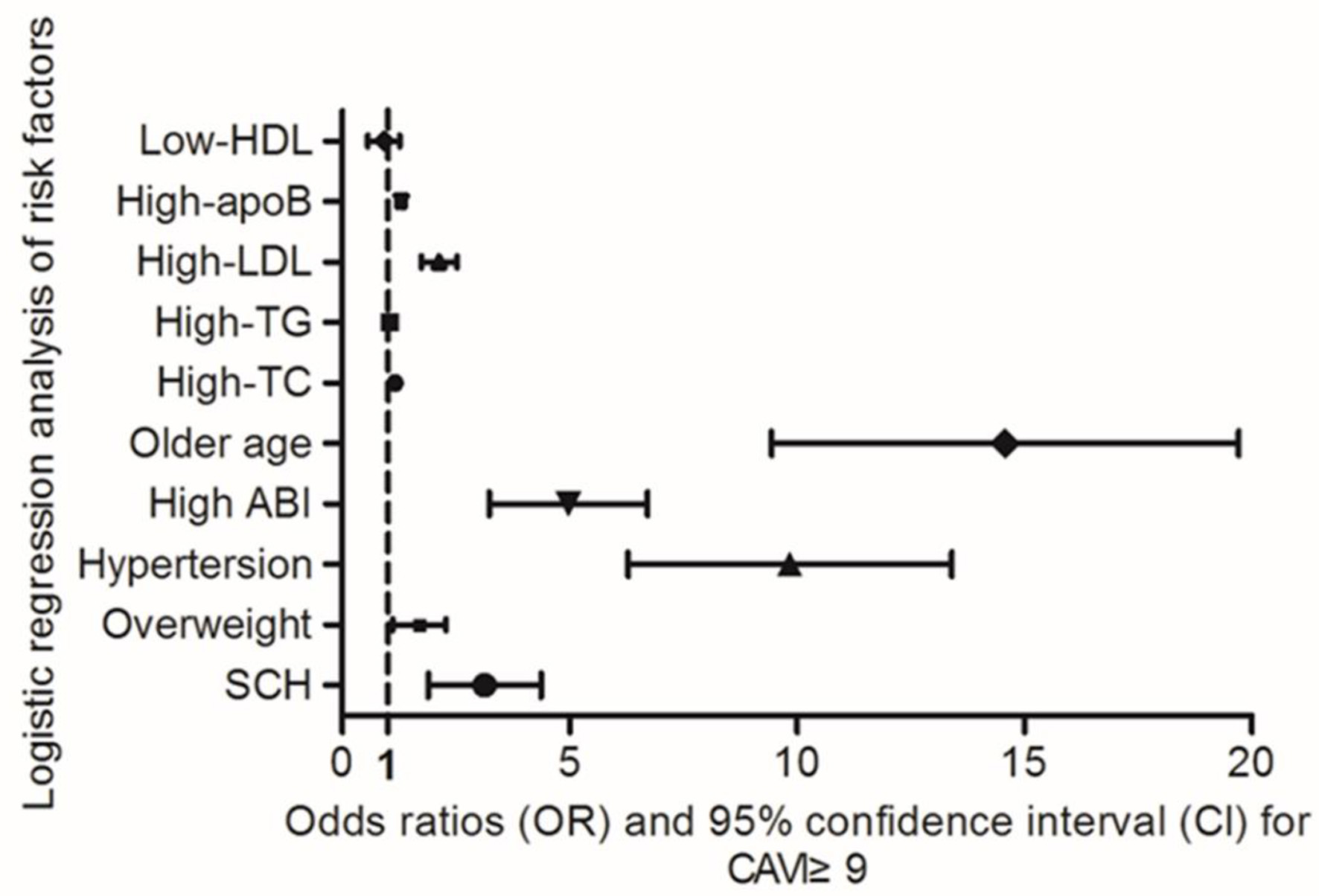
Figure 2.
Figure 2. Logistic regression analysis of factors associated with elevated CAVI (≥ 9). CAVI was dichotomized into normal (< 9, coded 0) and abnormal (≥ 9, coded 1). Similarly, older age, hypertension, overweight, high LDL, high TG, low HDL, high ABI, and high apoB were defined as binary variables (presence = 1, absence = 0). ABI: ankle-brachial index; apoB: apolipoprotein B; CAVI: cardio-ankle vascular index; HDL: high-density lipoprotein; LDL: low-density lipoprotein; TG: triglycerides.

Tables

Table 1. Anthropometric Indicators of the Studied Population
 
IndicatorsControl (n = 1,749)SCH (n = 247)P value
BMI: body mass index; BMR: basal metabolic rate; DBP: diastolic blood pressure; HR: heart rate; SBP: systolic blood pressure; SCH: subclinical hypothyroidism; WC: waist circumference.
Female (%)1,011 (57.8)139 (56.3)0.680
Age (years)48.32 ± 10.1948.41 ± 13.750.654
Height (cm)164.80 ± 7.58164.10 ± 8.280.131
Weight (kg)64.83 ± 11.5866.60 ± 12.380.043
BMI (kg/m2)23.69 ± 3.3524.22 ± 3.230.034
WC (cm)81.72 ± 10.0483.81 ± 9.880.004
SBP (mm Hg)123.2 ± 17.92125.2 ± 17.490.077
DBP (mm Hg)76.57 ±12.2476.25 ± 11.200.915
HR (bpm)79.75 ± 11.9275.19 ± 10.95< 0.001
BMR1,507 ± 212.21,359 ± 243.2< 0.001
Fat (%)22.51 ± 4.8827.94 ± 6.55< 0.001
Fat (kg)16.18 ± 4.9122.43 ± 4.06< 0.001


Table 2. Blood Biochemical Indicators of the Studied Population
 
IndicatorsControlSCHP value
apoA: apolipoprotein A; apoB: apolipoprotein B; FBG: fasting blood glucose; HDL: high-density lipoprotein; hsCRP: hypersensitivity C-reactive protein; LDL: low-density lipoprotein; SCH: subclinical hypothyroidism; TC: total cholesterol; TG: triglycerides.
TC (mmol/L)4.98 ± 0.925.43 ± 1.01< 0.001
TG (mmol/L)1.87 ± 1.492.19 ± 1.590.001
HDL (mmol/L)1.39 ± 0.361.36 ± 0.360.311
LDL (mmol/L)3.07 ± 0.833.31 ± 0.890.002
apoA (g/L)1.55 ± 0.251.53 ± 0.250.582
apoB (g/L)0.99 ± 0.231.09 ± 0.25< 0.001
apoB/apoA0.66 ± 0.190.73 ± 0.210.003
FBG (mmol/L)5.55 ± 1.255.48 ± 1.100.095
hsCRP (mg/L)0.83 ± 1.561.33 ± 2.780.051


Table 3. Comparison of the Arteriosclerosis Indicators in Subjects With Euthyroidism and Subclinical Hypothyroidism
 
IndicatorsControl (n = 1,749)SCH (n = 247)P value
ABI: ankle-brachial index; baPWV: brachial-ankle pulse wave velocity; CAVI: cardio-ankle vascular index; SCH: subclinical hypothyroidism.
CAVI7.04 ± 1.317.93 ± 1.38< 0.001
CAVI ≥ 9, n (%)98 (5.60)37 (14.98)0.004
ABI1.11 ± 0.081.22 ± 0.08< 0.001
ABI ≥ 1.3, n (%)12 (0.69)5 (2.02)0.049
baPWV (cm/s)1,346 ± 279.81,418 ± 302.50.003
baPWV ≥ 1,800, n (%)101 (5.77)26 (10.53)0.008