| Journal of Endocrinology and Metabolism, ISSN 1923-2861 print, 1923-287X online, Open Access |
| Article copyright, the authors; Journal compilation copyright, J Endocrinol Metab and Elmer Press Inc |
| Journal website https://jem.elmerpub.com |
Original Article
Volume 16, Number 4, August 2026, pages 190-200

Association Between Mortality and Weight Loss in Critical Patients: A Propensity Matching Study
Wei Huanga, d, Yi Zhao Zhangb, d, Xin Yu Wuc, d, Xiang Hong Chenc, e, Qian Chena, e
aDepartment of Orthopedics, School of Medicine, the Sixth Affiliated Hospital of South China University of Technology (Nanhai District People’s Hospital of Foshan), Foshan 528200, China
bDepartment of Radiology, School of Medicine, the Sixth Affiliated Hospital of South China University of Technology (Nanhai District People’s Hospital of Foshan), Foshan 528200, China
cDepartment of Pediatrics, School of Medicine, the Sixth Affiliated Hospital of South China University of Technology (Nanhai District People’s Hospital of Foshan), Foshan 528200, China
dWei Huang, Yi Zhao Zhang, and Xin Yu Wu contributed equally to this work.
eCorresponding Authors: Xiang Hong Chen, Department of Pediatrics, School of Medicine, the Sixth Affiliated Hospital of South China University of Technology (Nanhai District People’s Hospital of Foshan), Foshan 528200, China; Qian Chen, Department of Orthopedics, School of Medicine, the Sixth Affiliated Hospital of South China University of Technology (Nanhai District People’s Hospital of Foshan), Foshan 528200, China
Manuscript submitted March 5, 2026, accepted April 1, 2026, published online August 24, 2026
Short title: Mortality and Weight Loss in ICU Patients
doi: https://doi.org/10.14740/jem1638
| Abstract | ▴Top |
Background: Malnutrition is prevalent among critically ill patients and significantly impacts clinical outcomes. This study aimed to investigate the association between weight loss (a proxy for nutritional depletion) and mortality in intensive care unit (ICU) patients.
Methods: A retrospective cohort analysis was conducted using data from 29,217 ICU patients in the Medical Information Mart for Intensive Care III (MIMIC-III) database. Patients were stratified into weight-loss and non-weight-loss groups. Propensity score matching (PSM) was employed to balance baseline characteristics. Multivariable logistic and Cox regression analyses were performed to assess associations between weight loss and outcomes.
Results: Weight-loss patients exhibited significantly higher short- and long-term mortality rates compared to non-weight-loss patients (90-day: 18.9% vs. 13.6%, P = 0.002; 180-day: 21.8% vs. 16.9%, P = 0.002, 365-day: 31.3% vs. 24.2%, P = 0.001). Weight loss was also associated with prolonged mechanical ventilation (27.1% vs. 14.2%, P < 0.001), renal replacement therapy (4.1% vs. 0.9%, P < 0.001), and extended ICU/hospital stays. Adjusted regression models confirmed weight loss as an independent risk factor for short-term and long-term mortality.
Conclusions: Weight loss is significantly associated with mortality and adverse outcomes in critically ill patients. Early nutritional assessment and intervention are essential to improve prognosis.
Keywords: Weight loss; Mortality; Intensive care unit; Propensity score matching
| Introduction | ▴Top |
It is estimated that up to 60% of hospitalized patients are affected by malnutrition, which is defined as an imbalance between the availability of nutrients and the physiological demand for those nutrients [1–3]. Clinicians have challenges in meeting the calorie needs of critically ill patients due to gastrointestinal feeding intolerance, gastrointestinal dysmotility, gut microbial dysbiosis, and high energy demand [4]. In addition, malnutrition is made worse in critically ill populations due to metabolic stress, inflammation, and comorbidities [5, 6]. Therefore, malnutrition is more common in critically ill patients [7]. Weight loss, a key indicator of malnutrition, has been consistently linked to mortality in chronic diseases such as cancer, respiratory diseases, renal insufficiency, and heart failure [8–12]. The correlation between weight loss and death has been the subject of mixed findings in a number of research. After losing weight, the mortality rate is either higher [13–16] or stays the same [17], according to recent research. Among patients with life-threatening diseases, there is little evidence. In order to better guide our therapeutic intervention on the nutritional status of patients, we need to have a better understanding of the relationship between the nutritional status of patients in the intensive care unit (ICU) and the prognosis of the disease.
This study leverages the Medical Information Mart for Intensive Care III (MIMIC-III) database to evaluate the association between weight loss (defined by ICD-9 codes for malnutrition and abnormal weight reduction) and clinical outcomes in ICU patients [18].
| Materials and Methods | ▴Top |
Sources of data
The MIMIC-III is an open critical care medicine database that was collaboratively released by the Laboratory for Computational Physiology at Massachusetts Institute of Technology, Beth Israel Deacon Medical Center (BIDMC), and Philips Medical with the support of the National Institutes of Health (NIH). The MIMIC-III database gathered hospitalization information for more than 50,000 patients admitted to the ICU in BIDMC from June 2001 to October 2012.
Selection of participants
All patients admitted to ICU were extracted and were categorized into weight-loss and non-weight-loss groups based on ICD-9 diagnoses.
The exclusion criteria were as follows: 1) patients who were not admitted to ICU for the first time; 2) patients younger than 18 years old; 3) patients who died in hospital; and 4) patients with data missing more than 5%.
Data collection and definitions
Baseline features from the MIMIC-III database were obtained using a standard SQL query, encompassing fundamental information, critical illness scores, vital signs, comorbidities, laboratory test results from the first day of ICU admission, and clinical outcomes. Fundamental information included gender, age, ethnicity, admission and discharge times for the hospital and ICU, as well as the day of death. Critical illness scores comprised the Sequential Organ Failure Assessment (SOFA) score, Glasgow Coma Scale (GCS), and Oxford Acute Severity of Illness Score (OASIS). Vital indicators comprised heart rate, mean arterial pressure (MAP), respiratory rate, body temperature, pulse oxygen saturation (SpO2), systolic blood pressure (SBP), and diastolic blood pressure (DBP). Comorbidities encompassed congestive heart failure (CHF), hypertension, stroke, chronic obstructive pulmonary disease (COPD), diabetes, renal failure, liver disease, cancer, and coagulation problems. Laboratory analyses encompassed white blood cell count (WBC), hemoglobin, platelet count, hematocrit, international normalized ratio (INR), prothrombin time (PT), partial thromboplastin time (PTT), blood urea nitrogen (BUN), creatinine, serum potassium, serum sodium, bicarbonate, chloride, glucose, and anion gap. Clinical outcomes encompassed both primary and secondary outcomes. The primary outcomes encompassed mortality rates at 90, 180, and 365 days. Secondary outcomes encompassed mechanical ventilation (MV, exceeding 72 h post-admission), renal replacement therapy (RRT), vasopressor utilization (exceeding 24 h post-admission), ICU stays (exceeding 3 days), and hospital stays (exceeding 14 days).
Statistical analysis
Continuous data were expressed as medians (interquartile ranges), whereas categorical variables were represented as frequency and percentage. The Shapiro-Wilk test was initially conducted to assess the normality of continuous variables. The t-test or Mann-Whitney U test was utilized for comparing continuous variables, whereas categorical variables were assessed using Chi-square or Fisher’s exact tests.
Logistic and Cox regression analyses were employed to illustrate the association between weight loss status in patients and clinical outcomes. Multivariate logistic and Cox regression analyses were conducted to compensate for all covariates listed in Table 1. To account for missing data mechanisms and reduce bias, we employed multiple imputations and repeated the primary outcome analysis as per Rubin’s rules. Propensity score matching (PSM) was conducted to reduce confounding bias, incorporating all factors into the analysis. One-to-one nearest-neighbor matching was implemented using a caliper width of 0.2. A standardized mean difference (SMD) was employed to assess the outcome of PSM. A criterion of 0.1 was deemed acceptable. An inverse probability of treatment weighting (IPTW) model was employed to create a weighted cohort utilizing the predicted propensity scores as weights. Standardized mortality ratio weighting (SMRW), propensity score matching weighting (PSMW), and overlap weighting (OW) were employed to adjust the covariates, hence ensuring the robustness of our findings. We utilized Kaplan-Meier and log-rank analyses to differentiate 365-day survival curves, both before and following matching, PSMW, and IPWT.
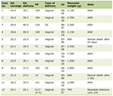 Click to view | Table 1. Comparisons of Characteristics Between the Original Cohort and Matched Cohort |
The R package “MICE” was utilized to execute the neighbor interpolation method, subsequently employed to impute any missing data. All analyses were conducted utilizing the statistical software tool R version 3.4.3 (R Foundation for Statistical Computing, Vienna, Austria). A P-value criterion of less than 0.05 (two-tailed) was deemed statistically significant.
Ethics approval
This study was conducted in accordance with the ethical principles outlined in the Declaration of Helsinki. The research protocol was authorized by the BIDMC and the Institutional Review Boards of MIT following completion of the CITI (Record ID# 40362987).
| Results | ▴Top |
Study population and baseline characteristics
Based on the ICD-9 diagnoses of weight loss, weight loss was defined mainly as malnutrition or low body weight. With data of 54,269 ICU patients in the MIMIC-III database reviewed, a total of 29,217 patients were included in the original cohort after applying the exclusion criteria. Among them, a total of 28,258 patients without weight loss were defined as group 1, while 959 patients with weight loss were defined as group 2. Before matching, there were significant differences in almost all variables between the two groups. After the PSM, 957 patients with weight loss and 957 patients without weight loss were successfully matched and included in this study. The flow chart of screening and matching is shown in Figure 1. After matching, there was a significant difference in body weight between the two groups, in addition to which almost all SMD were less than 0.1, showing the effectiveness of PSM. Baseline characteristics before and after matching are both presented in Table 1. Visualized comparison curves of weighted data before and after matching are shown in Figure 2.
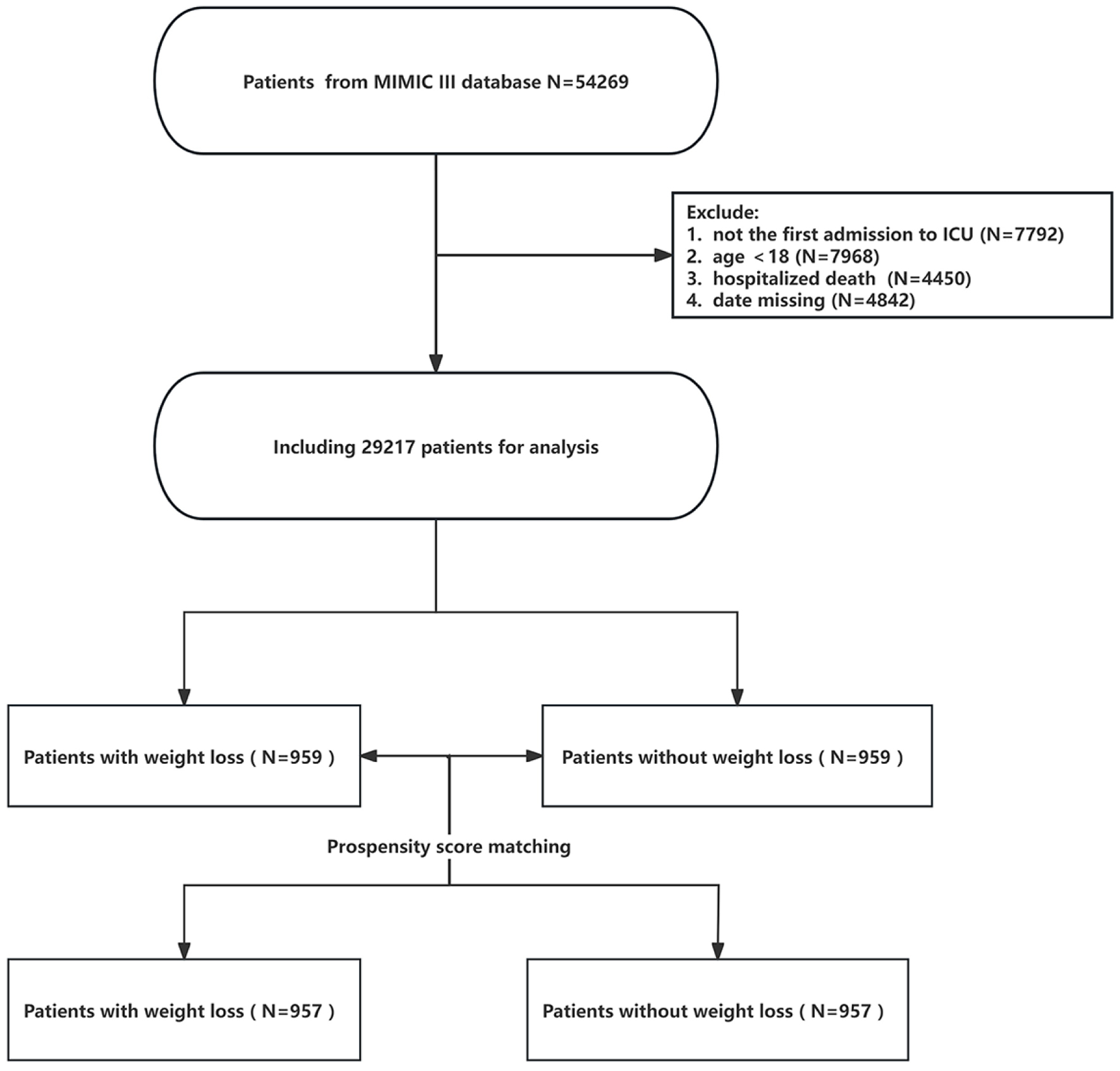 Click for large image | Figure 1. Flow diagram for data inclusion in the present study. |
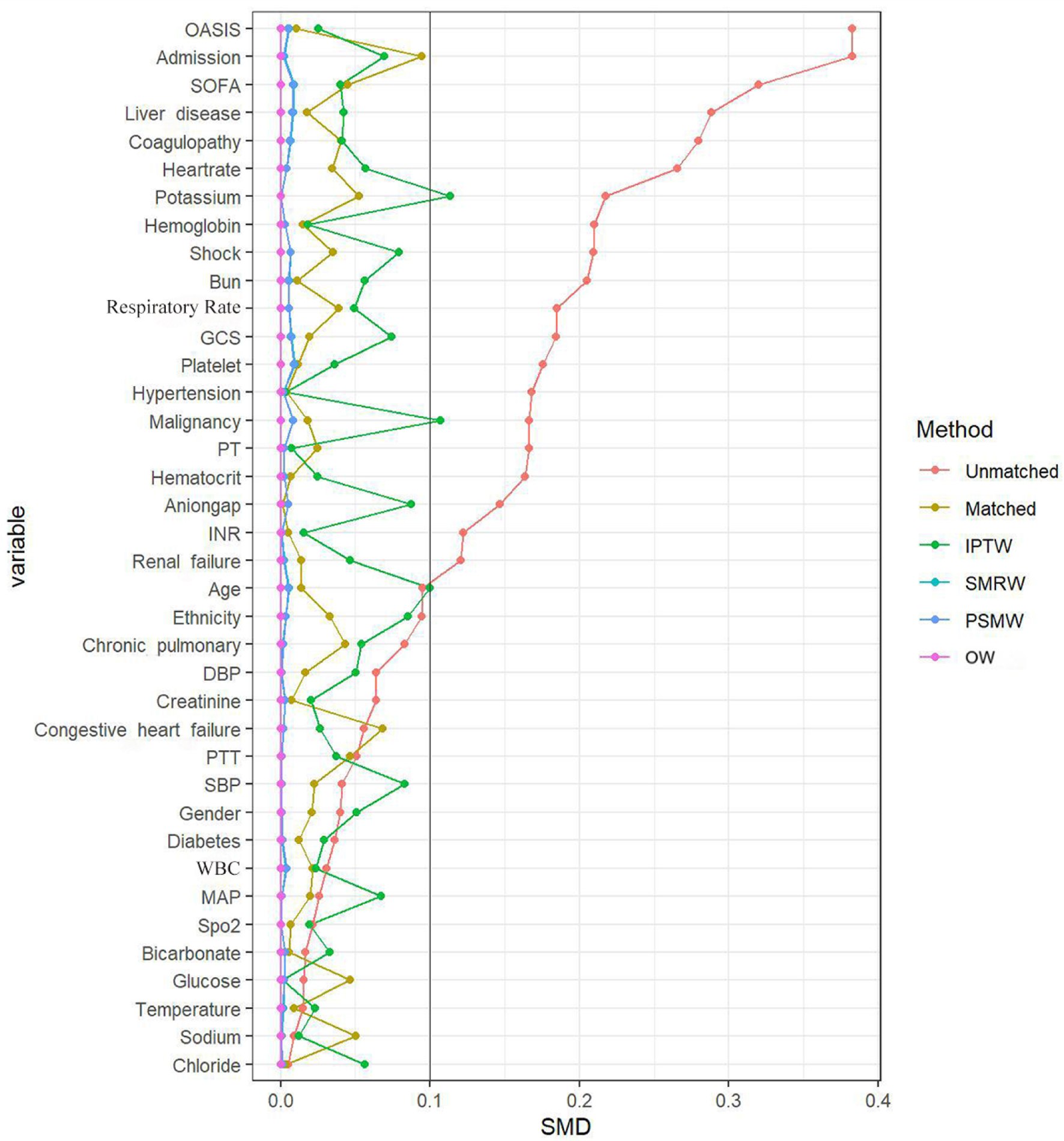 Click for large image | Figure 2. Plot of standardized mean difference after propensity score analysis. IPTW: inverse probability of treatment weighting; SMRW: standardized mortality ratio weighting; PSMW: propensity score matching weighting; OW: overlap weighting. |
Primary outcome
Statistically significant differences in mortality existed between the two groups both before and after matching, demonstrating that patients experiencing weight loss had elevated short-term and long-term mortality rates. Following propensity score matching, the 90-day mortality rates for patients with and without weight loss were 18.9% and 13.6%, respectively (P = 0.002), while the 180-day mortality rates were 21.8% and 16.9%, respectively (P = 0.008). The 365-day mortality rates were 31.3% and 24.2%, respectively (P = 0.001), indicating a substantial difference (Table 2). The outcomes of multivariate logistic regression and Cox regression, both prior to and during adjustment, exhibited statistical differences. Comorbid weight loss was identified as a risk factor for mortality at 90, 180, and 365 days in ICU patients (Tables 3 and 4). The Kaplan-Meier curves illustrated that the mortality rate among weight-loss patients exceeds that of non-weight-loss patients, with a statistically significant difference between the groups (Fig. 3).
Click to view | Table 2. Clinical Outcomes Analysis on the Original Cohort and Matched Cohort |
Click to view | Table 3. Logistic Regression Analysis of Clinical Outcomes on the Original Cohort and Matched Cohort |
Click to view | Table 4. Cox Regression Analysis of Clinical Outcomes on the Original Cohort and Matched Cohort |
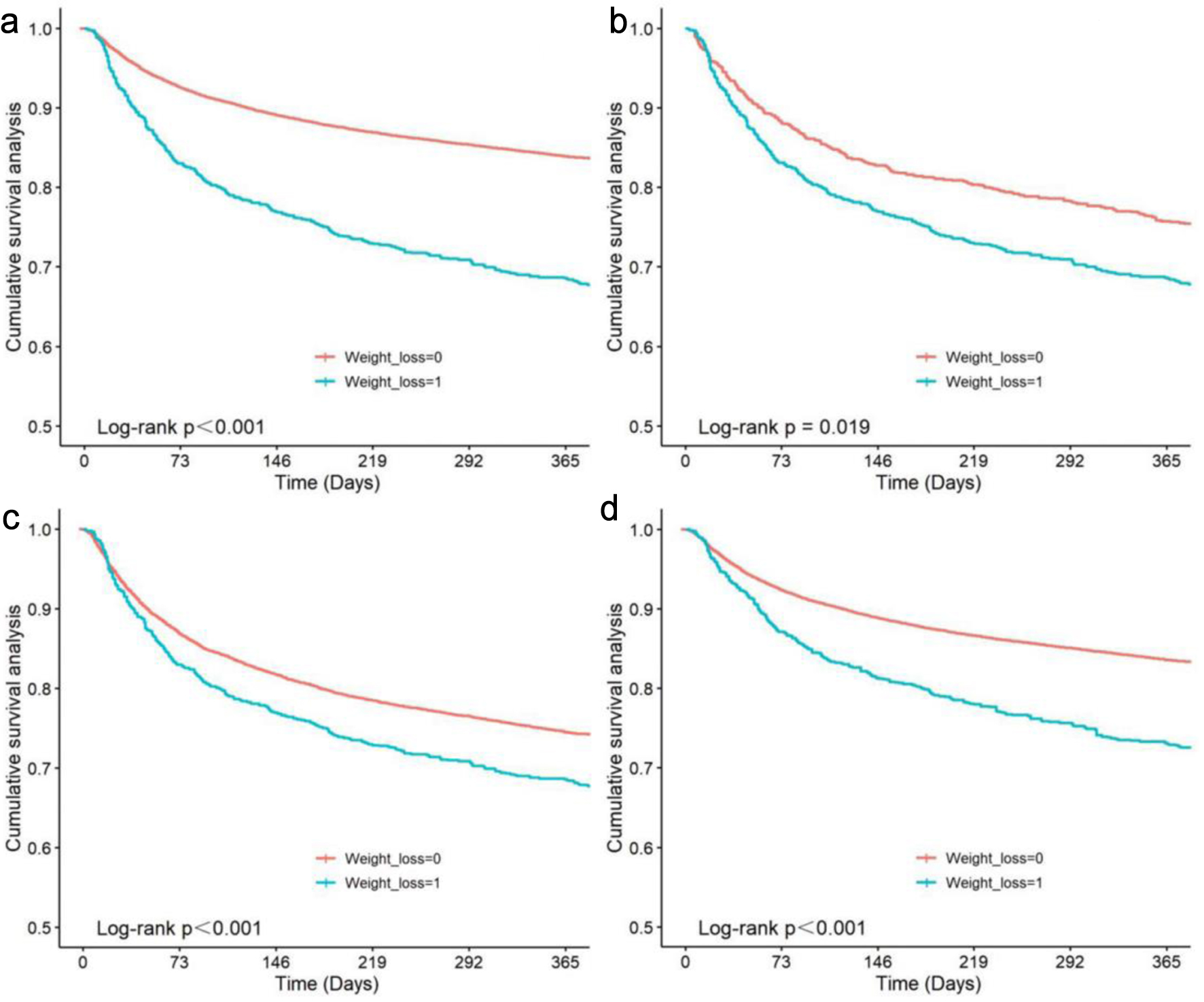 Click for large image | Figure 3. Kaplan-Meier curves for 365-day survival probability comparing two groups. (a) Before matched. (b) After matched. (c) Propensity score matching weighting (PSMW). (d) Inverse probability weighting (IPWT). The red line represents patients without weight loss and the blue line represents patients with combined weight loss. |
Secondary outcomes
Following PSM, the proportion of patients requiring extended MV in group 1 and group 2 was 14.2% (136/957) and 27.1% (259/957), respectively. The incidence of patients undergoing RRT was 0.9% (9/957) and 4.1% (39/957), respectively. In comparison to group 1, patients in group 2 exhibited a higher likelihood of being in the ICU for over 3 days (39.7% (380/957) vs. 55.5% (531/957), P < 0.001), and this trend was also observed for the duration of hospital stay longer than 14 days (22.5% (215/957) vs. 54.0% (517/957), P < 0.001). The usage of vasopressors between the two groups prior to matching was statistically significant; however, no statistically significant difference was observed between the groups post-matching. In logistic regression analysis, comorbid weight loss emerged as a significant risk factor for the extension of MV, utilization of RRT, prolonged ICU stay, and duration of hospital stay, both before and after adjustments were made. Comprehensive results are presented in Tables 3 and 4.
Sensitivity analysis
In the entire cohort, after adjusting for all covariates in Table 1, the risk factor for 365-day mortality in patients experiencing weight loss was 1.40 (95% confidence interval (CI), 1.25–1.58, P < 0.001), as corroborated by multivariate analysis using the Cox hazard model. The hazard ratio (HR) values consistently ranged from 1.28 to 1.74 across various adjustment and matching methods. Likewise, following the implementation of multivariate logistic regression analysis, it was determined that the risk factor for 365-day death in patients experiencing weight loss was 1.57 (95% CI, 1.34–1.84, P < 0.001), with odds ratio (OR) values consistently ranging from 1.34 to 1.87 using various adjustment and matching methods. The results were illustrated in a forest map, as depicted in Figure 4.
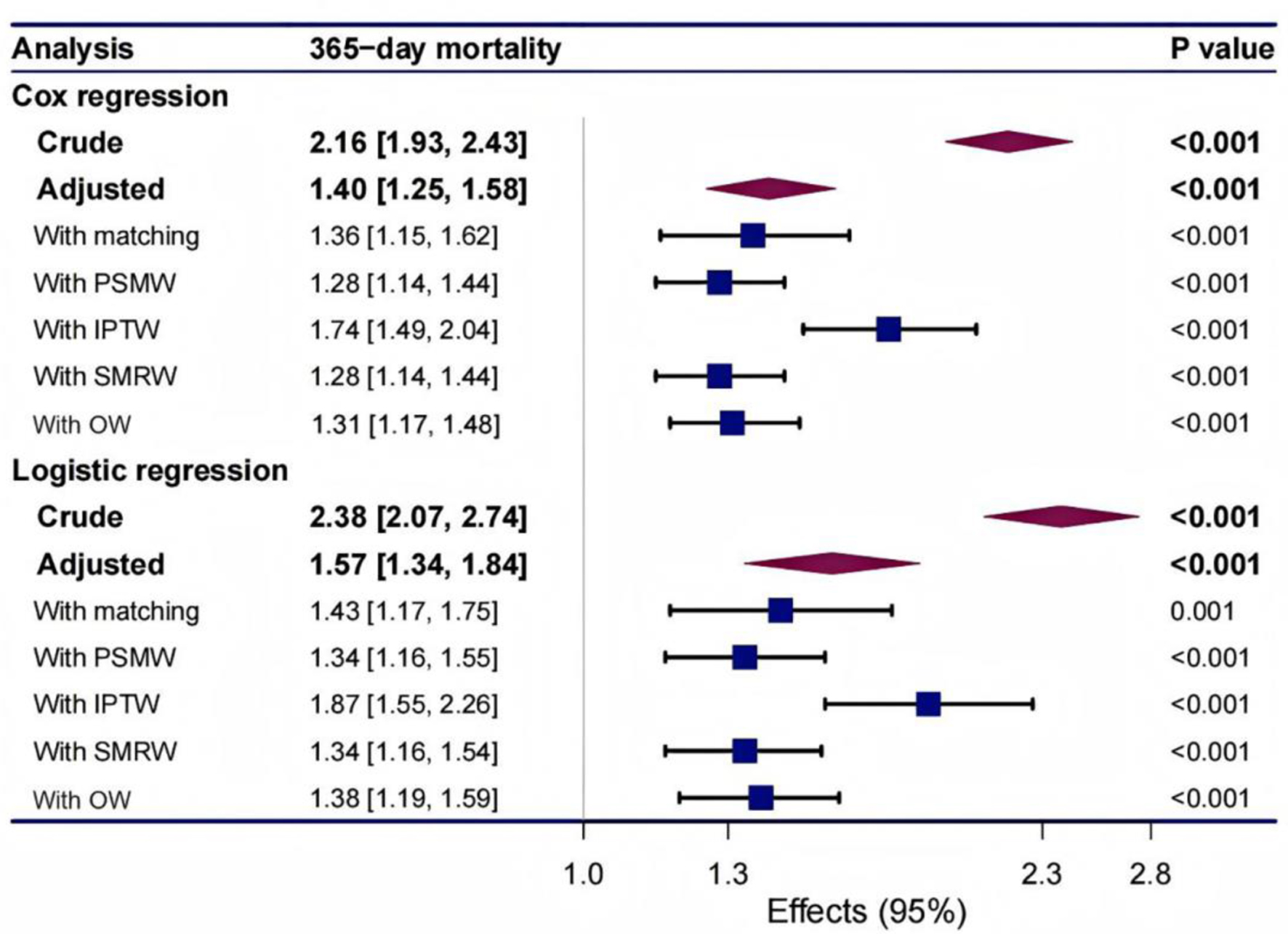 Click for large image | Figure 4. The forest plot of logistic and Cox regression analysis for 365-day mortality. PSMW: propensity score matching weighting; IPTW: inverse probability of treatment weighting; SMRW: standardized mortality ratio weighting; OW: overlap weighting. |
| Discussion | ▴Top |
This retrospective study provides evidence that weight loss, as a marker of nutritional depletion, is significantly associated with increased short- and long-term mortality, prolonged MV, higher rates of RRT, and extended ICU/hospital stays among critically ill patients. Below, we contextualize these results, discuss potential mechanisms, and highlight implications for clinical practice and future research.
Our analysis revealed that weight-loss patients exhibited markedly higher mortality rates at 90 days (18.9% vs. 13.6%), 180 days (21.8% vs. 16.9%), and 365 days (31.3% vs. 24.2%) compared to non-weight-loss patients. These findings are in line with previous research on chronic conditions, including heart failure and chronic obstructive pulmonary disease (COPD), which has shown that unintended weight loss is associated with a worse chance of survival [15, 19]. Multiple potential causes may account for the increased risk of ICU death in patients undergoing weight loss. Initially, the early stages of critical illness are marked by heightened energy consumption, leading to a state of hypermetabolism [20]. Any sickness can result in malnutrition, which may be exacerbated by critical illness if patients become immunocompromised and incapable of mounting an effective inflammatory response, rendering them vulnerable to adverse outcomes [21]. Second, weight loss often coexists with chronic comorbidities (e.g., heart failure, COPD, cancer), which independently increase mortality risk. Our regression model adjusted for these conditions, suggesting weight loss itself may contribute to poor prognosis beyond comorbidity burden [22]. The association between weight loss and secondary outcomes, such as prolonged MV (27.1% vs. 14.2%) and RRT (4.1% vs. 0.9%), further highlights the systemic impact of nutritional depletion. Multiple factors may explain the association between weight loss and the increased risk of extended mechanical breathing in ICU patients. Weight loss may impact ventilatory drive and pulmonary defense systems, drain energy reserves, result in muscle mass reduction, and potentially induce electrolyte imbalances such as hypophosphatemia, which can be linked to diminished muscular contractile strength. Oxidative stress resulting from micronutrient deficits due to weight loss may significantly contribute to ventilator-induced diaphragmatic dysfunction. Weakness of the respiratory muscles may extend respiratory failure and hinder the weaning process from artificial support [23]. Likewise, weight reduction impacts renal function in ICU patients. Patients undergoing weight loss have demonstrated a reduced glomerular filtration rate and renal plasma flow, alongside diminished urine reabsorption capacity and acid excretion, potentially leading to increased reliance on renal replacement therapy [24]. Similar to other studies, the present study found weight loss as an independent risk factor for prolonged length of stay both in hospital and ICU [22, 25]. Weight-loss patients are in a state of nutritional loss, which increases their risk of infection, renal and liver dysfunction [26], and oxygen utilization deficiency [27], thereby affecting the prognosis. Notably, the non-significant difference in vasopressor use following propensity matching indicates that hemodynamic instability may be less directly linked to nutritional status than previously thought. This lack of difference likely reflects both the high baseline prevalence of vasoactive agents in the ICU population and propensity matching’s efficacy in balancing underlying illness severity, thereby minimizing detectable between-group variation in pharmacologic support.
Strengths and limitations
Consistent with Yu et al’s findings regarding BMI and mortality, this study reveals that underweight is predictive of an elevated risk, while overweight or obesity is associated with a reduced mortality risk [28]. Our study’s strengths include its large sample size (n = 29,217), rigorous adjustment for confounders via PSM, and sensitivity analyses using IPTW, SMRW, OW, and PSMW. The consistency of HRs (1.28–1.74) and ORs (1.34–1.87) across multiple models strengthens the validity of our conclusions. Furthermore, the use of the MIMIC-III database ensures standardized data collection, minimizing inter-center variability.
However, several limitations must be acknowledged. First, the retrospective design precludes causal inferences; weight loss may reflect underlying disease severity rather than directly causing mortality. Second, reliance on ICD-9-coded weight loss diagnoses may underestimate true nutritional risk due to four key limitations: 1) inability to capture subclinical malnutrition or dynamic changes (e.g., from admission to discharge), 2) lack of quantitative data on weight change magnitude, 3) no adjustment for fluid balance, and 4) dichotomous classification that overlooks etiology. This classification limitation inherently constrains mechanistic interpretation but strengthens the clinical relevance of our mortality association, as the codes reflect provider-recognized malnutrition with care implications. Third, we used body weight as a proxy for nutritional status due to inconsistent height data in MIMIC-III, which precluded reliable BMI calculation. Fourth, this may affect standardization but was unavoidable. Excluding patients with > 5% missing data may introduce selection bias, though multiple imputations mitigated this risk. Finally, the single-center nature of MIMIC-III limits generalizability to diverse healthcare settings. Future prospective studies are required to determine causality and evaluate the impact of dietary treatments in ICU populations. Research should incorporate BMI where possible and investigate the relationships among weight loss, inflammation, organ dysfunction, and medications with the aim of developing biomarkers to inform individualized treatment. Ultimately, integrating dynamic nutritional evaluations into the EHR may improve real-time monitoring and interventions.
Conclusions
Weight loss is a significant factor of mortality among critically ill patients. Nutritional assessment and intervention are needed to improve the prognosis from the patient’s admission to the ICU.
Acknowledgments
Any support given that is not covered by the author’s contribution or funding sections.
Financial Disclosure
None to declare.
Conflict of Interest
The authors declare no conflict of interest.
Informed Consent
Due to the retrospective design and use of fully anonymized data from the MIMIC-III database, the requirement for informed consent from participants was waived by the institutional review boards. This waiver is consistent with ethical guidelines for secondary data analysis, where data cannot be linked to individuals.
Author Contributions
WH collected data, analyzed it, and wrote the manuscript. YZZ and XYW were involved in the study’s conception, design, and coordination and helped draft the paper. XHC and QC was in charge of the entire project, reviewing the article, planning the study, and supervising it. All of the authors contributed to the paper and approved the final version.
Data Availability
The data supporting the findings of this study are available from the corresponding author upon reasonable request.
| References | ▴Top |
- Blossner MDOMM. Malnutrition: quantifying the health impact at national and local levels. Geneva: World Health Organization (WHO environmental burden of disease series, no.12), 2005.
- Pablo AM, Izaga MA, Alday LA. Assessment of nutritional status on hospital admission: nutritional scores. Eur J Clin Nutr. 2003;57(7):824-831.
doi pubmed - Kyle UG, Genton L, Pichard C. Hospital length of stay and nutritional status. Curr Opin Clin Nutr Metab Care. 2005;8(4):397-402.
doi pubmed - Vong T, Yanek LR, Wang L, Yu H, Fan C, Zhou E, Oh SJ, et al. Malnutrition Increases Hospital Length of Stay and Mortality among Adult Inpatients with COVID-19. Nutrients. 2022;14(6).
doi pubmed - Jensen GL, Wheeler D. A new approach to defining and diagnosing malnutrition in adult critical illness. Curr Opin Crit Care. 2012;18(2):206-211.
doi pubmed - Lew CCH, Yandell R, Fraser RJL, Chua AP, Chong MFF, Miller M. Association between malnutrition and clinical outcomes in the intensive care unit: a systematic review [Formula: see text]. JPEN J Parenter Enteral Nutr. 2017;41(5):744-758.
doi pubmed - White JV, Guenter P, Jensen G, Malone A, Schofield M, Academy of N, Dietetics Malnutrition Work G, et al. Consensus statement of the Academy of Nutrition and Dietetics/American Society for Parenteral and Enteral Nutrition: characteristics recommended for the identification and documentation of adult malnutrition (undernutrition). J Acad Nutr Diet. 2012;112(5):730-738.
doi pubmed - Wada H, Ikeda A, Maruyama K, Yamagishi K, Barnes PJ, Tanigawa T, Tamakoshi A, et al. Low BMI and weight loss aggravate COPD mortality in men, findings from a large prospective cohort: the JACC study. Sci Rep. 2021;11(1):1531.
doi pubmed - Cabezas-Rodriguez I, Carrero JJ, Zoccali C, Qureshi AR, Ketteler M, Floege J, London G, et al. Influence of body mass index on the association of weight changes with mortality in hemodialysis patients. Clin J Am Soc Nephrol. 2013;8(10):1725-1733.
doi pubmed - Rossignol P, Masson S, Barlera S, Girerd N, Castelnovo A, Zannad F, Clemenza F, et al. Loss in body weight is an independent prognostic factor for mortality in chronic heart failure: insights from the GISSI-HF and Val-HeFT trials. Eur J Heart Fail. 2015;17(4):424-433.
doi pubmed - Shea MK, Nicklas BJ, Houston DK, Miller ME, Davis CC, Kitzman DW, Espeland MA, et al. The effect of intentional weight loss on all-cause mortality in older adults: results of a randomized controlled weight-loss trial. Am J Clin Nutr. 2011;94(3):839-846.
doi pubmed - Jackson SE, Heinrich M, Beeken RJ, Wardle J. Weight loss and mortality in overweight and obese cancer survivors: a systematic review. PLoS One. 2017;12(1):e0169173.
doi pubmed - Sauvaget C, Ramadas K, Thomas G, Vinoda J, Thara S, Sankaranarayanan R. Body mass index, weight change and mortality risk in a prospective study in India. Int J Epidemiol. 2008;37(5):990-1004.
doi pubmed - Sorensen TI, Rissanen A, Korkeila M, Kaprio J. Intention to lose weight, weight changes, and 18-y mortality in overweight individuals without co-morbidities. PLoS Med. 2005;2(6):e171.
doi pubmed - Diaz VA, Mainous AG, 3rd, Everett CJ. The association between weight fluctuation and mortality: results from a population-based cohort study. J Community Health. 2005;30(3):153-165.
doi pubmed - Droyvold WB, Lund Nilsen TI, Lydersen S, Midthjell K, Nilsson PM, Nilsson JA, Holmen J, et al. Weight change and mortality: the Nord-Trondelag Health Study. J Intern Med. 2005;257(4):338-345.
doi pubmed - Wannamethee SG, Shaper AG, Lennon L. Reasons for intentional weight loss, unintentional weight loss, and mortality in older men. Arch Intern Med. 2005;165(9):1035-1040.
doi pubmed - Johnson AE, Pollard TJ, Shen L, Lehman LW, Feng M, Ghassemi M, Moody B, et al. MIMIC-III, a freely accessible critical care database. Sci Data. 2016;3:160035.
doi pubmed - Zamora E, Diez-Lopez C, Lupon J, de Antonio M, Domingo M, Santesmases J, Troya MI, et al. Weight loss in obese patients with heart failure. J Am Heart Assoc. 2016;5(3):e002468.
doi pubmed - Secombe P, Harley S, Chapman M, Aromataris E. Feeding the critically ill obese patient: a systematic review protocol. JBI Database System Rev Implement Rep. 2015;13(10):95-109.
doi pubmed - Sharma K, Mogensen KM, Robinson MK. Pathophysiology of critical illness and role of nutrition. Nutr Clin Pract. 2019;34(1):12-22.
doi pubmed - Perera LAM, Chopra A, Shaw AL. Approach to patients with unintentional weight loss. Med Clin North Am. 2021;105(1):175-186.
doi pubmed - Bagri NK, Jose B, Shah SK, Bhutia TD, Kabra SK, Lodha R. Impact of malnutrition on the outcome of critically ill children. Indian J Pediatr. 2015;82(7):601-605.
doi pubmed - Benabe JE, Martinez-Maldonado M. The impact of malnutrition on kidney function. Miner Electrolyte Metab. 1998;24(1):20-26.
doi pubmed - Lim SL, Ong KC, Chan YH, Loke WC, Ferguson M, Daniels L. Malnutrition and its impact on cost of hospitalization, length of stay, readmission and 3-year mortality. Clin Nutr. 2012;31(3):345-350.
doi pubmed - Zhang H, Zhang X, Dong L. Nutritional status plays a crucial role in the mortality of critically ill patients with acute renal failure. J Investig Med. 2018;66(2):309-318.
doi pubmed - Czapla M, Juarez-Vela R, Gea-Caballero V, Zielinski S, Zielinska M. The association between nutritional status and in-hospital mortality of COVID-19 in critically-ill patients in the ICU. Nutrients. 2021;13(10).
doi pubmed - Yu W, Jiang W, Yuan J, Fan T, Xiao H, Sun L, Zhu Y, et al. Association between BMI and outcomes in critically ill patients: an analysis of the MIMIC-III database. Sci Rep. 2024;14(1):31127.
doi pubmed
This article is distributed under the terms of the Creative Commons Attribution 4.0 International License (CC BY 4.0), which permits unrestricted use, distribution, and reproduction in any medium, including commercial use, provided the original work is properly cited.
Journal of Endocrinology and Metabolism is published by Elmer Press Inc.