

Diabetes Drives Cardiovascular Risk in the Metabolic Triad: An Eight-Year Occupational Cohort Study of Ten Thousand Workers
DOI:
https://doi.org/10.14740/jem1583Keywords:
Obesity, Body mass index, Diabetes mellitus, Hypertension, Epidemiologic factors, Public healthAbstract
Background: Cardiovascular diseases remain the leading cause of death and maintain a high burden in Latin America. Obesity, hypertension, and type 2 diabetes are independent risk factors, but their coexistence could amplify cardiovascular damage beyond their individual sum. The aim of our study was to determine, in a Peruvian occupational cohort followed for 8 years, how the coexistence of obesity, hypertension, and diabetes is associated with the incidence of major cardiovascular events and to identify which combinations confer the highest risk.
Methods: This was a retrospective observational cohort study of Peruvian workers without cardiovascular history, followed for 8 years. Obesity, hypertension, and diabetes were evaluated in eight mutually exclusive categories. The outcome was cardiovascular disease. Adjusted risk ratios were estimated using Cox regression, adjusted for age, sex, cholesterol, and triglycerides.
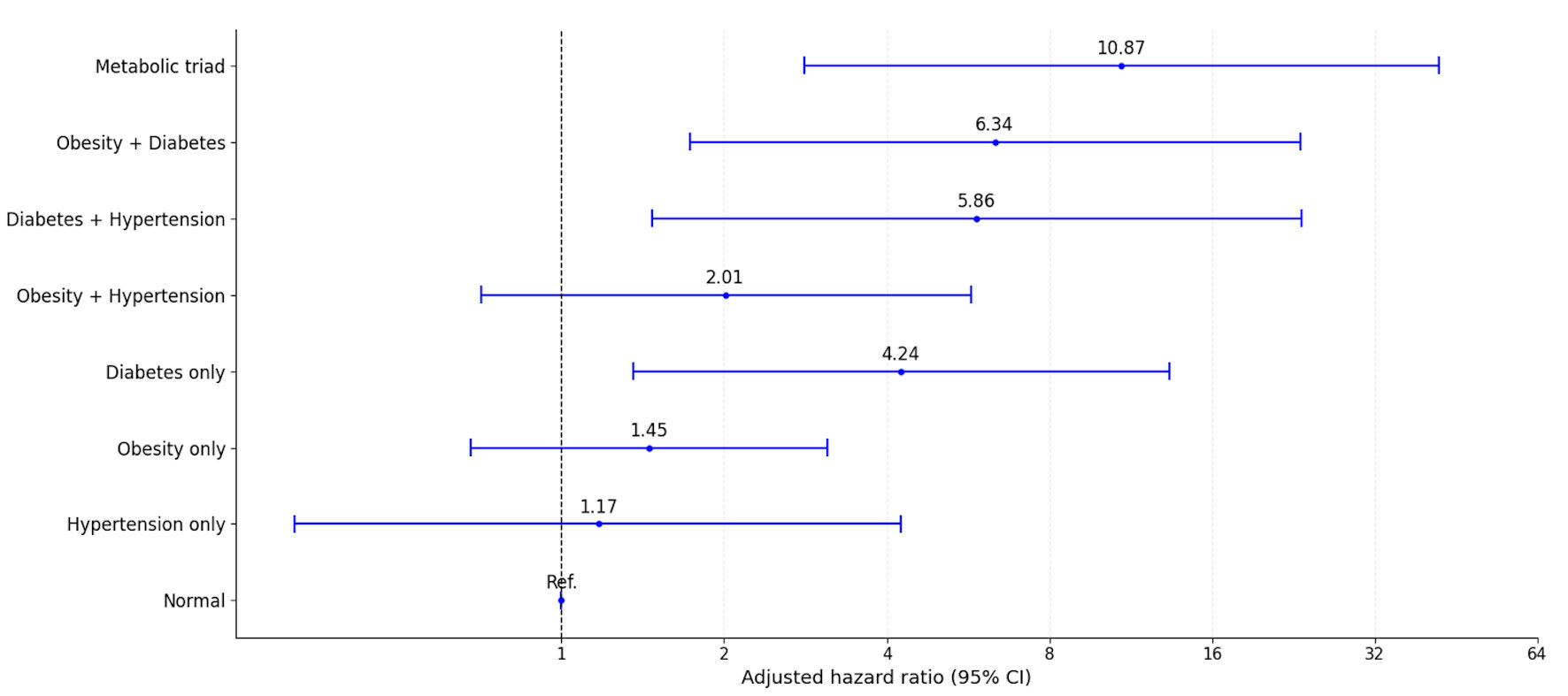
Results: A progressive risk increase pattern was observed where the group without components had an incidence of 1.30 per 1,000 person-years, while the triad reached 34.94 per 1,000 person-years with adjusted hazard ratio (aHR) = 10.87 (2.81 - 42.06). Among isolated components, diabetes showed the highest risk (aHR = 4.24; 1.36 - 13.35) compared to obesity (1.45; 0.68 - 3.10) and hypertension (1.17; 0.32 - 4.24). In combinations, obesity + diabetes (aHR = 6.34; 1.73 - 23.27) and diabetes + hypertension (5.86; 1.47 - 23.39) concentrated the highest risks, above obesity + hypertension (2.01; 0.71 - 5.72).
Conclusions: In the working population, the coexistence of obesity, hypertension, and diabetes progressively increases CVD risk, with diabetes as the main axis and the triad identifying a very high-risk subgroup. These findings support periodic screening and intensive multifactorial management in the occupational setting, prioritizing those presenting diabetes alone or in combination.
Published
Issue
Section
License
Copyright (c) 2025 The authors

This work is licensed under a Creative Commons Attribution-NonCommercial 4.0 International License.