

Nonlinear Relationship Between Serum 25-Hydroxyvitamin D and Glycemic Control Among US Adults: A Survey-Weighted Analysis of NHANES 2017–2018
DOI:
https://doi.org/10.14740/jem1658Keywords:
Vitamin D, HbA1c, NHANES, Glycemic control, Diabetes, Nonlinear association, Restricted cubic splineAbstract
Background: Vitamin D has been implicated in glucose metabolism through effects on pancreatic β-cell function, insulin sensitivity, and systemic inflammation. However, epidemiologic studies evaluating the association between serum 25-hydroxyvitamin D (25(OH)D) and glycemic control have yielded inconsistent findings after adjustment for adiposity and lifestyle-related factors. The objective was to evaluate the association between serum 25(OH)D concentrations and glycemic control in a nationally representative sample of US adults, with emphasis on potential nonlinear relationships.
Methods: We performed a cross-sectional analysis of adults aged ≥ 18 years from the National Health and Nutrition Examination Survey (NHANES) 2017–2018. Participants with available data on serum 25(OH)D, glycated hemoglobin (HbA1c), and covariates were included. Survey-weighted multivariable linear regression models were adjusted for age, sex, race/ethnicity, body mass index (BMI), and physical activity. Serum 25(OH)D was analyzed both categorically and continuously. Restricted cubic spline regression with four knots was used to assess nonlinear associations.
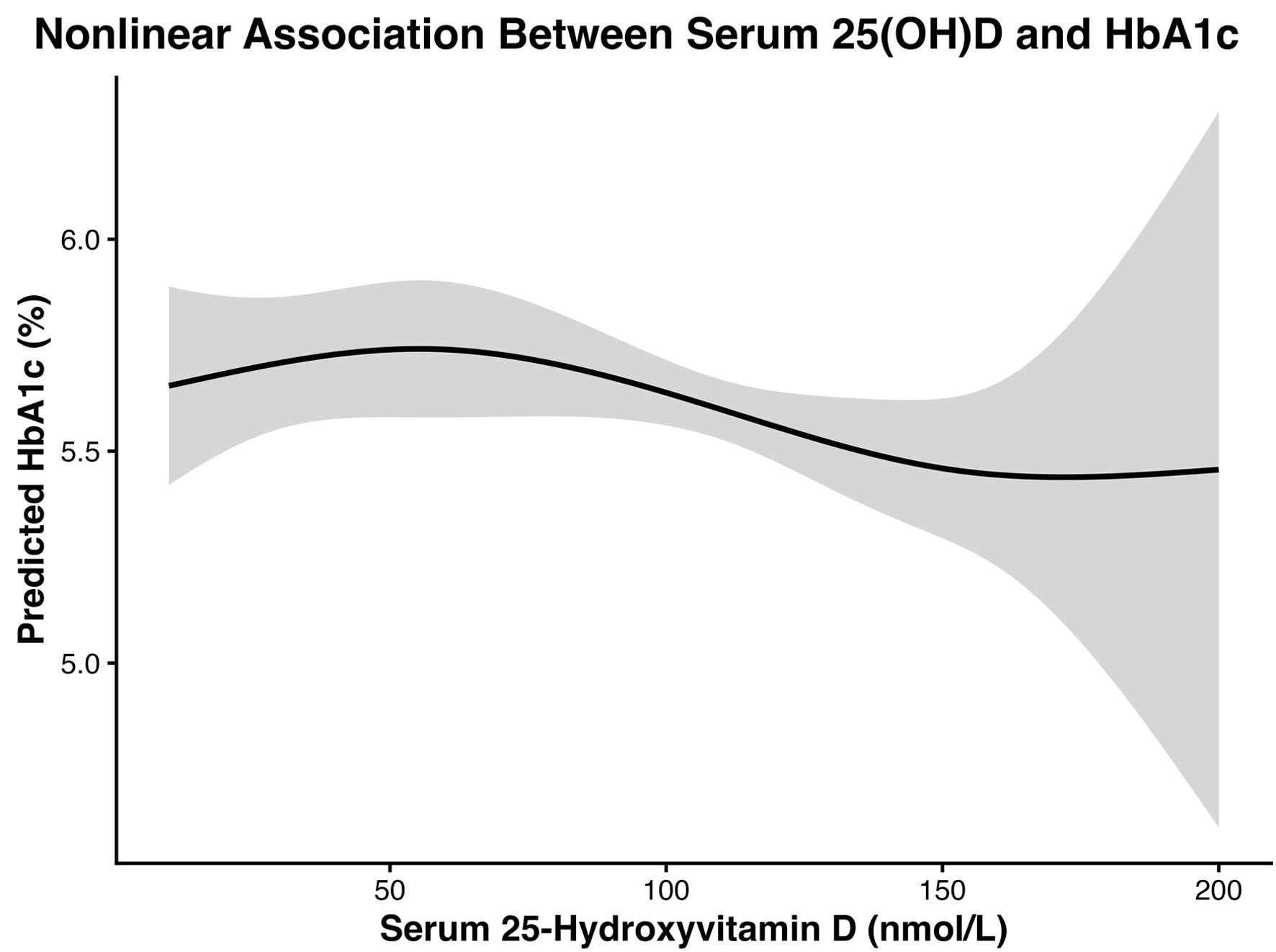
Results: A total of 5,136 adults were included. Vitamin D insufficiency was not significantly associated with HbA1c compared with deficiency (β = −0.051; 95% confidence interval (CI) −0.120 to 0.019; P = 0.156), whereas vitamin D sufficiency was associated with lower HbA1c levels (β = −0.189; 95% CI −0.263 to −0.115; P < 0.001). Increasing age and BMI were independently associated with higher HbA1c, while physical activity was inversely associated with HbA1c. Restricted cubic spline modeling demonstrated a nonlinear, non-monotonic association between serum 25(OH)D and HbA1c, with HbA1c remaining relatively stable at lower vitamin D concentrations and declining modestly at higher concentrations.
Conclusions: Serum 25(OH)D demonstrated a modest nonlinear association with HbA1c in US adults. Although higher vitamin D concentrations were associated with lower HbA1c levels, the effect size was small, suggesting that vitamin D may reflect broader metabolic health rather than serve as a primary determinant of glycemic control.
Published
Issue
Section
License
Copyright (c) 2026 The authors

This work is licensed under a Creative Commons Attribution 4.0 International License.