

Prevalence, Geographic Distribution, and Socioeconomic Disparities of Normal-Weight Central Obesity: An Analysis of 46,493 Adults
DOI:
https://doi.org/10.14740/jem1639Keywords:
Central obesity, Normal weight, Waist circumference, Spatial analysis, Health inequities, PeruAbstract
Background: Normal-weight central obesity (NWCO) represents a metabolically adverse phenotype that is often overlooked when nutritional status is assessed using body mass index (BMI) alone. This study aimed to determine the prevalence of NWCO among Peruvian adults, characterize its geographic distribution using spatial autocorrelation, assess socioeconomic inequalities, and analyze temporal trends from 2018 to 2024.
Methods: An analytical cross-sectional study using ENDES 2018–2024 data with directly measured anthropometric information was conducted. Adults aged ≥18 years with normal weight (BMI 18.5–24.9 kg/m2) were included. NWCO was defined as waist circumference ≥ 80 cm in women or ≥ 90 cm in men. Prevalences were estimated accounting for the complex survey design; socioeconomic inequalities were assessed using the Slope Index of Inequality (SII), Relative Index of Inequality (RII), and concentration index; temporal trends were evaluated using linear regression; spatial autocorrelation was examined using global Moran’s I and local indicators of spatial association (LISA); and an ATP III-based sensitivity analysis was performed using waist circumference cutoffs of ≥ 88 cm in women and ≥ 102 cm in men.
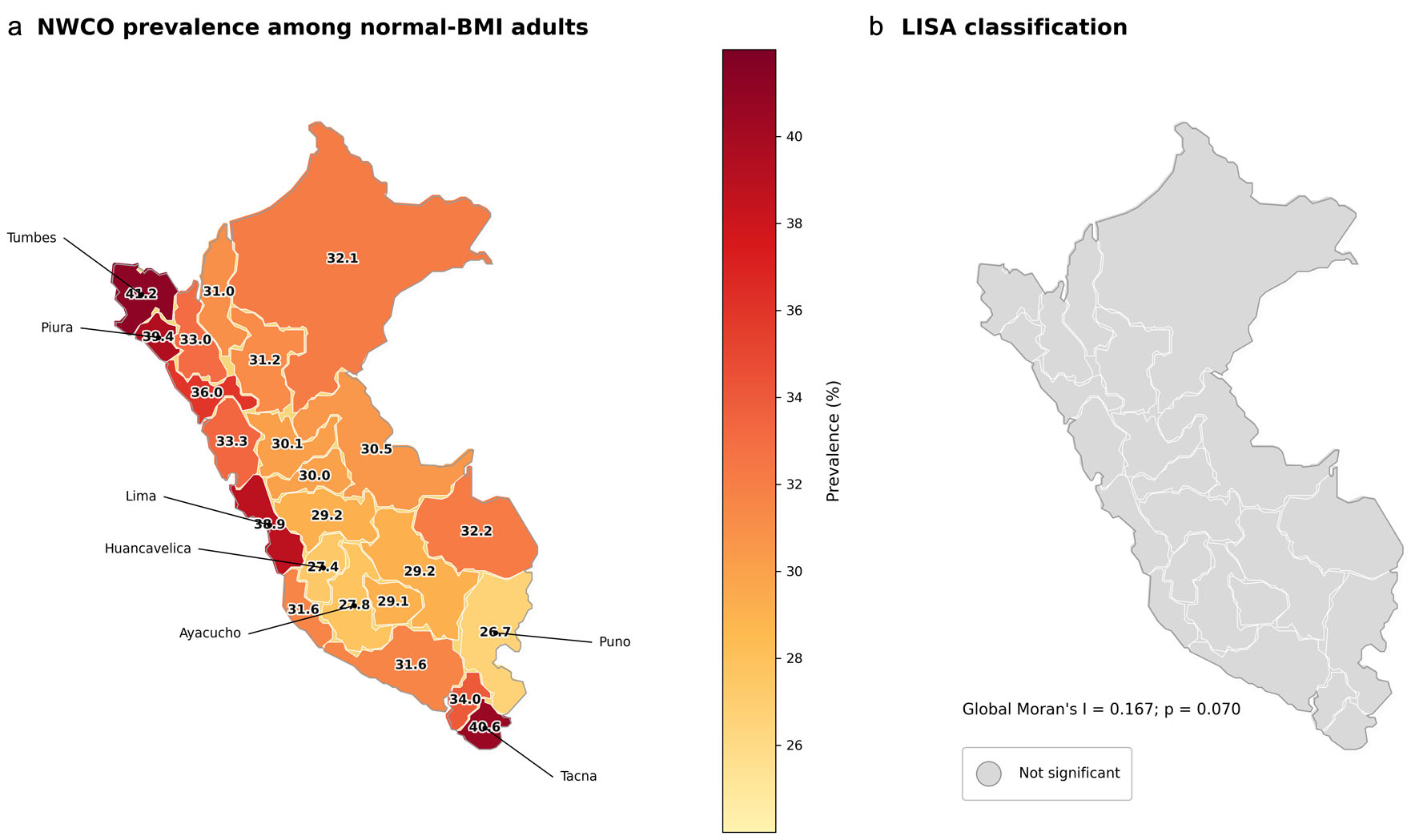
Results: Among 46,493 adults with normal weight, 15,907 (35.1%; 95% confidence interval (CI): 34.4–35.9%) had NWCO. Prevalence was higher in women (58.9%) than in men (14.2%) and increased with age (25.0% in 18–29 years vs. 48.9% in ≥ 60 years). A positive socioeconomic gradient was observed: 26.7% in the lowest wealth quintile to 46.4% in the highest wealth quintile (SII = 0.23; RII = 1.93; concentration index = 0.100). At the departmental level, NWCO prevalence among adults with normal BMI ranged from 24.0% in Huancavelica to 41.9% in Tacna. Global Moran’s I was 0.167 (P = 0.070), and no significant LISA clusters were identified. No statistically significant temporal change was observed overall (−0.46 percentage points per year (pp/year), P = 0.172), among men (−0.21 pp/year, P = 0.356), or among women (−0.63 pp/year, P = 0.101). In sensitivity analyses using ATP III cutoffs, NWCO prevalence was substantially lower (8.0%; 95% CI: 7.6–8.4%) but remained concentrated among women and higher wealth groups.
Conclusions: More than one-third of Peruvian adults with normal weight have central obesity, with a female predominance, concentration in higher socioeconomic strata, and marked geographic heterogeneity without statistically significant spatial clustering after correction of the departmental estimand. These findings support incorporating waist circumference measurement into routine adult clinical assessment, including primary care visits, even when BMI is within the normal range.
Published
Issue
Section
License
Copyright (c) 2026 The authors

This work is licensed under a Creative Commons Attribution 4.0 International License.